Our conference will take place at Anadolu University, Yunus Emre Campus. To provide you with options for your accommodation, special discounted rates have been arranged with the following hotels.
Nova Vista Eskisehir Centrum Hotel, a member of Radisson Individuals
Single
Double
Triple
NOVA VISTA CENTRUM RADISSON INDIVIDUALS
4.100 TL
5.100 TL
6.100 TL
Nova Vista Deluxe & Suites Eskisehir, a member of Radisson Individuals
Single
Double
Triple
NOVA VISTA DELUXE RADISSON INDIVIDUALS
3.800 TL
4.800 TL
5.800 TL
Reservation Contacts
Gülşah YILDIRIM: +90 552 783 50 86
Aykut EKİCİ: +90 533 724 62 49
Şebnem KAYA: +90 533 724 62 76
Important Notes & Terms
Open buffet breakfast and taxes are included in the specified rates.
The rates listed above are exclusive to the IHEC (YÖÇAD) organization. These discounted rates are valid until October 1, 2026.
Full payment for the accommodation will be collected from guests upon reservation.
Payments are non-refundable in case of cancellation.
Hotel guests can utilize our parking facilities.
Guests staying at Nova Vista Deluxe can use the sauna and fitness center free of charge.
The rates specified above are corporate rates. Reservations not officially confirmed in writing by your organization/institution cannot benefit from these special rates.
Check-in time is after 14:00, and check-out time is before 12:00. For check-outs between 12:00 and 17:00, a half-day room rate will be charged; for check-outs after 17:00, a full-day room rate will apply.
Early check-in or late check-out requests will be accommodated subject to hotel availability.
The role of SDGs in the Global Higher Education & Quality Assurance Ecosystem
Bio
Professor Olgun Cicek is currently affiliated with the University of Ljubljana as a Senior Researcher in a Horizon Europe project. He is an international expert in quality assurance and accreditation, microcredentials, and internationalisation strategies for higher education institutions. Over the past three decades, Professor Cicek has held senior leadership, advisory, external examiner, and keynote speaker roles in higher education institutions, quality assurance agencies, ministries, and international organisations. His experience includes collaboration with INQAAHE in Spain, CHEA-CIQG in the United States, the TNE Institute in the United Kingdom, as well as various ministries and national and regional higher education networks across Europe and beyond, covering three continents.
Abstract
In today’s interconnected global environment, higher education is expected not only to transmit knowledge, but also to build understanding across cultures, promote global citizenship, advance sustainability, and prepare learners for a rapidly transforming future. In this context, the role of SDGs in the global higher education and quality assurance ecosystem has become increasingly significant, as they provide a shared framework for aligning institutional missions, educational outcomes, research priorities, social responsibility, and international engagement with broader societal needs.
Quality Assurance in Higher Education therefore has a more strategic role than ever before. It is no longer limited to compliance and accountability; rather, it must serve as a dynamic instrument for trust-building, innovation, relevance, inclusion, sustainability, and continuous improvement. By integrating the Sustainable Development Goals into quality assurance frameworks, institutions and quality assurance agencies can promote a more holistic understanding of quality—one that connects academic standards with ethical responsibility, equity, employability, lifelong learning, environmental awareness, and measurable societal impact.
At the same time, as artificial intelligence reshapes teaching, learning, assessment, research, and institutional management, quality assurance systems must evolve to ensure that innovation is accompanied by integrity, transparency, fairness, inclusion, and academic standards. A future-oriented quality assurance approach should help institutions address key questions: How do we ensure that AI enhances learning rather than weakens critical thinking?
How do we maintain fairness, ethics, and reliability in assessment? How do we preserve the human, cultural, social, and sustainability dimensions of education in an increasingly digital world?
At the global level, quality assurance can act as a bridge—connecting systems, supporting recognition, fostering mobility, promoting sustainable development, and strengthening confidence among institutions, students, employers, policymakers, and societies. In an AI-driven and sustainability-focused world, our shared responsibility is to ensure that higher education remains human-centered, internationally connected, socially responsible, and quality-driven.
Maurizio Tira, EUA Board Member
University of Brescia, Italy
Universities for Sustainability beyond 2030: navigating long-term transformation
Bio
Maurizio Tira is Full Professor of Urban and regional Planning at the University of Brescia, where he served as Rector from 2016 to 2022. He is member of the Board of EUA, delegated to sustainability, to the Executive Committee of the Magna Charta Observatory and the EUA-CDE-Steering Committee. Past-President of the Italian Society of Urban Planners, he is member of the Board of the Academy of Science, Letters and Arts in Brescia and Corresponding Member of the Academy of Science of Bologna and the Academy of Science of Region Lombardy. He is member of the Transport Research Committee of the International Transport Forum (at OECD) as representative of the Italian Government, President of Consortium GARR “The ultra-broadband network dedicated to the Italian research and education community” and member of the board of the “National Centre for HPC, Big Data and Quantum Computing”, as representative of the Italian Minister of University and Research. In December 2020 he has been appointed Commander of the Order of Merit of the Italian Republic.
Abstract
Many of the defining challenges of our time, climate change, biodiversity loss, demographic change, technological disruption and social fragmentation, unfold across generations rather than political cycles. They require institutions capable of combining long-term thinking with action in the present. Universities are among the few institutions that naturally operate across generations. They educate future citizens and professionals, preserve and create knowledge, and provide spaces for critical reflection and dialogue. This unique position gives universities a particular capacity and opportunity to address long-term societal challenges. The ways in which universities contribute to sustainable development are likely to influence how they evolve as institutions, just as changes within universities may shape their capacity to contribute to sustainable societies. The speech will briefly present the result of the EUA’s survey on “Sustainability and greening in European higher education” and some consideration on how universities can contribute to sustainability beyond 2030 and how they can strengthen their capacity to help societies navigate long-term transformation.
Aras Bozkurt
Anadolu University, Türkiye
Fifty Shades of AI
Bio
Aras Bozkurt is a researcher and faculty member at Anadolu University, Türkiye. With MA and PhD degrees in distance education, Dr. Bozkurt’s work focuses on empirical studies in areas such as distance education, online learning, networked learning, and educational technology. He applies critical theories like connectivism, rhizomatic learning, and heutagogy to his research. Dr. Bozkurt is also interested in emerging research paradigms, including social network analysis, sentiment analysis, and data mining. Dr. Bozkurt’s studies also cover the integration of artificial intelligence technologies into educational processes in the axis of human-machine interaction.
Abstract
Artificial intelligence has stopped being a peripheral tool in higher education and become a structural force reshaping who learns, who teaches, and who is even present in the room. This keynote, Fifty Shades of AI, rejects the binary of pro-AI versus anti-AI and instead examines the spectrum of tensions educators now navigate. It traces the gap between formal AI policy and informal AI use, the emergence of the “ghost student” enabled by agentic AI browsers, and the blurred line between organic and synthetic content in research and writing. It confronts cognitive debt, where short-term gains from AI assistance produce long-term losses in independent thinking, alongside the cultural and institutional fault lines that shape who adopts AI and who resists it. Drawing on recent scholarship on AI literacy, agentic AI governance, and human-AI interaction, the talk argues that resilience, not acceptance or rejection, is the only viable institutional posture. It closes with four unresolved questions about credentialing, agency, architecture, and intellectual debt, leaving the audience not with solutions but with the obligation to choose deliberately. The shade we choose reveals more about us than about the technology itself.
Oral presentations typically cover completed or nearly completed research. Researchers will present their work and then respond to any explanatory feedback and questions from the audience and session chair. Presenters should be careful with their time allocation, and session chairs may adjust the timing based on the number of presentations. Each oral presentation will be planned for 15 minutes.
Abstract for Oral Presentation: The abstract should be between 500-750 words, excluding references, and include the following sections:
Description of the problem,
Aim of the study or Research question(s),
Conceptual/Theoretical Framework,
Research Method (for empirical work),
Findings (preliminary findings for work in progress)/Discussion points, and
Each symposium proposal must include minimum 3 maximum 5 presentations. The Symposium Discussant must introduce symposium presenters and submit the proposal (symposium summary and symposium presentation abstracts).
Symposium Summary: Excluding references, the summary should be between 500-700 words and include the description of the symposium, its purpose, conceptual/theoretical framework, the contribution of symposium presentations to the symposium, discussion points and conclusion.
Symposium Presentation Abstracts: Each abstract, excluding references, should be between 300-500 words and include the following sub-titles:
Description of the problem,
Aim of the study or Research question(s),
Conceptual/Theoretical Framework,
Research Method (for empirical work),
Findings (preliminary findings for work in progress)/Discussion points, and
Roundtable sessions allow high interaction among presenters and with attendees. It would be more appropriate for junior researchers and work-in-progress research studies. The discussions will take place in a small group of session presenters clustered around shared interests in a roundtable/boardroom setting. A moderator who is knowledgeable about the research area facilitates interaction and participation. The moderator introduces the discussion topic and session presenters briefly. Then, the discussion focuses on specific questions and challenges. The conclusions such as key-learnings, ideas on the next steps and concrete actions are drawn.
Abstract for Roundtable Session: Session presenters are required to submit a paper or commentary paper addressing central questions regarding the issue under consideration. Excluding references, the abstract should be between 350-400 words. Commentary papers need to address the elements required for paper submissions:
Purposes;
Perspectives(s) or theoretical framework;
Methods, techniques or modes of inquiry;
Data Sources,
Results and/or substantiated conclusions for arguments, and
Expectations from the session regarding the research and/or questions
The conference languages are Turkish and English. Those who submit abstracts in English are required to present in English.
IHEC 2026 is a peer-reviewed scientific conference. All submitted papers/symposiums will be evaluated by at least two expert reviewers within the framework of a double-blind review process. Acceptance or rejection decisions will be based on the reviewers’ evaluations.
Participants of jointly authored works must each pay the participation fee to attend the conference. A participant may present a maximum of two papers, and an author’s name may appear in up to three papers.
To be included in the conference program, registration must be completed by September 7, 2025.
Participants may choose to publish the papers presented orally at the conference either in the YÖÇAD Full Text Proceedings Book (in Turkish or English) or in the Higher Education Governance & Policy (HEGP) published under YÖÇAD, subject to the peer review process.
Below are details regarding the publication processes:
(1) Full Text Proceedings Book process conducted by YÖÇAD:
The deadline for submitting full texts in Turkish or English for the Proceedings Book is November 1, 2026. Full texts prepared should be submitted in the specified format to yocad.ihec@gmail.com as a Word document. Submitted Full Text Papers by participating authors will be sent to print following the approval of the book editors, after the authors have completed the suggested revisions.
(2) Journal process conducted in collaboration with the Higher Education Governance & Policy (HEGP):
The Higher Education Governance & Policy (HEGP) will be published in English. Papers presented in Turkish at the conference can also be published in this journal if translated into English. The journal’s regular annual publication process will be operated. The deadline for submitting texts in English is November 1, 2026, and details of the publication process can be accessed via the following links:
The printing of the articles will depend on the decisions made at the end of the peer review process conducted by the journal editors after the author’s conference participation is confirmed.
Higher Education for a Sustainable Future: 2030 and Beyond
Higher education systems play a central role in societal development through scientific knowledge production, the cultivation of qualified human resources and active citizens, and community engagement. As an open and complex system, higher education operates in constant interaction with society, the economy, culture, politics, and the environment. Therefore, while higher education institutions have the potential to shape the future of societies, higher education policies are formed around the socio-economic transformation paradigms of their time.
The current reflection of this dynamic is the closer alignment of higher education policies with sustainable development goals, driven by the increasing impacts of climate change and a stronger commitment to sustainability. This shift can be summarized as a transition from the neoliberal motto of “higher education for the global knowledge economy” (dominant since the 1990s) to “higher education for sustainable development.”
The sustainability agenda offers a powerful transformative potential for higher education policies and the institutional mission of universities across three main dimensions:
Addressing climate change and advancing sustainable development
Establishing a new social contract in response to the challenges of neoliberalism.
Offering a new strategic framework for societies and universities in times of uncertainty.
While Quality Education (SDG 4) and Gender Equality (SDG 5) are the goals most directly related to higher education, the “higher education for sustainable development” approach expects universities to play an active role in all sustainable development goals.
This transformation is currently visible in several key developments:
The strategic plans and policy documents of universities are increasingly linking research, education, and community service activities with the UN Sustainable Development Goals.
Alternative institutional concepts and models, such as the “sustainable university” and the “ecological university,” are emerging.
International ranking systems have begun measuring green campus initiatives and sustainability activities.
The twin green and digital transitions are gaining significant weight in research funding.
As the target year of 2030 for the Sustainable Development Goals approaches, the progress made toward these goals and the strategy for the post-2030 era are major topics of discussion among international organizations, particularly UNESCO. Therefore, the 9th International Higher Education Studies Conference (IHEC 2026) will focus on the following core sub-themes under the overarching theme of “Higher Education for a Sustainable Future”:
Sustainable university and ecological university models
Sustainability-oriented transformation of universities’ research, education, and community service missions
Integration of sustainability into curricula across different academic fields (sustainability education)
Integration of sustainability dimensions into quality assurance systems
Climate change strategies and action plans of universities
Green campus and “living lab” applications in universities
Sustainability metrics in international rankings
The relationship between artificial intelligence, digital transformation, sustainability, and higher education
Higher education scenarios for the post-2030 era
Furthermore, the fact that the UN Climate Change Conference (COP31) will be held in Turkey in November 2026 provides a significant motivation to focus on the transformative power of higher education for a sustainable future.
As YÖÇAD (Association for Higher Education Studies), we are pleased to collaborate under this shared theme with Anadolu University, which has served as an international model since its establishment through its contributions to lifelong learning and distance education, and continues to pioneer sustainability studies in various fields today.
General Conference Topics
The conference program is not limited to the main theme above; it is open to submissions on the following fundamental agendas of higher education studies:
Academic freedoms and university autonomy
Academic experiences and needs
Science and technology policies
Science communication
Regional development and higher education
Digitalization and artificial intelligence in education and research
Entrepreneurship, community contribution, development, and sustainability
Graduate student experiences and needs
Micro-credentials and flexible learning
Faculty training and development policies
Higher education for the Sustainable Development Goals
Mental health and well-being of university stakeholders
University-city relationships
University-industry/private sector collaboration and helix ecosystems
Undergraduate student experiences and needs
Experiences of foundation (private) universities
New generation universities and alternative university models
Internationalization of higher education
Ethics, principles, and values in higher education
Quality assurance in higher education
Pedagogical and andragogical approaches in higher education
Access to higher education, equal opportunity, diversity, and inclusion
Higher Education for a Sustainable Future: 2030 and Beyond
Higher education systems play a central role in societal development through scientific knowledge production, the cultivation of qualified human resources and active citizens, and community engagement. As an open and complex system, higher education operates in constant interaction with society, the economy, culture, politics, and the environment. Therefore, while higher education institutions have the potential to shape the future of societies, higher education policies are formed around the socio-economic transformation paradigms of their time.
The current reflection of this dynamic is the closer alignment of higher education policies with sustainable development goals, driven by the increasing impacts of climate change and a stronger commitment to sustainability. This shift can be summarized as a transition from the neoliberal motto of “higher education for the global knowledge economy” (dominant since the 1990s) to “higher education for sustainable development.”
The sustainability agenda offers a powerful transformative potential for higher education policies and the institutional mission of universities across three main dimensions:
Addressing climate change and advancing sustainable development
Establishing a new social contract in response to the challenges of neoliberalism.
Offering a new strategic framework for societies and universities in times of uncertainty.
While Quality Education (SDG 4) and Gender Equality (SDG 5) are the goals most directly related to higher education, the “higher education for sustainable development” approach expects universities to play an active role in all sustainable development goals.
This transformation is currently visible in several key developments:
The strategic plans and policy documents of universities are increasingly linking research, education, and community service activities with the UN Sustainable Development Goals.
Alternative institutional concepts and models, such as the “sustainable university” and the “ecological university,” are emerging.
International ranking systems have begun measuring green campus initiatives and sustainability activities.
The twin green and digital transitions are gaining significant weight in research funding.
As the target year of 2030 for the Sustainable Development Goals approaches, the progress made toward these goals and the strategy for the post-2030 era are major topics of discussion among international organizations, particularly UNESCO. Therefore, the 9th International Higher Education Studies Conference (IHEC 2026) will focus on the following core sub-themes under the overarching theme of “Higher Education for a Sustainable Future”:
Sustainable university and ecological university models
Sustainability-oriented transformation of universities’ research, education, and community service missions
Integration of sustainability into curricula across different academic fields (sustainability education)
Integration of sustainability dimensions into quality assurance systems
Climate change strategies and action plans of universities
Green campus and “living lab” applications in universities
Sustainability metrics in international rankings
The relationship between artificial intelligence, digital transformation, sustainability, and higher education
Higher education scenarios for the post-2030 era
Furthermore, the fact that the UN Climate Change Conference (COP31) will be held in Turkey in November 2026 provides a significant motivation to focus on the transformative power of higher education for a sustainable future.
As YÖÇAD (Association for Higher Education Studies), we are pleased to collaborate under this shared theme with Anadolu University, which has served as an international model since its establishment through its contributions to lifelong learning and distance education, and continues to pioneer sustainability studies in various fields today.
General Conference Topics
The conference program is not limited to the main theme above; it is open to submissions on the following fundamental agendas of higher education studies:
Academic freedoms and university autonomy
Academic experiences and needs
Science and technology policies
Science communication
Regional development and higher education
Digitalization and artificial intelligence in education and research
Entrepreneurship, community contribution, development, and sustainability
Graduate student experiences and needs
Micro-credentials and flexible learning
Faculty training and development policies
Higher education for the Sustainable Development Goals
Mental health and well-being of university stakeholders
University-city relationships
University-industry/private sector collaboration and helix ecosystems
Undergraduate student experiences and needs
Experiences of foundation (private) universities
New generation universities and alternative university models
Internationalization of higher education
Ethics, principles, and values in higher education
Quality assurance in higher education
Pedagogical and andragogical approaches in higher education
Access to higher education, equal opportunity, diversity, and inclusion
Oral presentations typically cover completed or nearly completed research. Researchers will present their work and then respond to any explanatory feedback and questions from the audience and session chair. Presenters should be careful with their time allocation, and session chairs may adjust the timing based on the number of presentations. Each oral presentation will be planned for 15 minutes.
Abstract for Oral Presentation: The abstract should be between 500-750 words, excluding references, and include the following sections:
Description of the problem,
Aim of the study or Research question(s),
Conceptual/Theoretical Framework,
Research Method (for empirical work),
Findings (preliminary findings for work in progress)/Discussion points, and
Each symposium proposal must include minimum 3 maximum 5 presentations. The Symposium Discussant must introduce symposium presenters and submit the proposal (symposium summary and symposium presentation abstracts).
Symposium Summary: Excluding references, the summary should be between 500-700 words and include the description of the symposium, its purpose, conceptual/theoretical framework, the contribution of symposium presentations to the symposium, discussion points and conclusion.
Symposium Presentation Abstracts: Each abstract, excluding references, should be between 300-500 words and include the following sub-titles:
Description of the problem,
Aim of the study or Research question(s),
Conceptual/Theoretical Framework,
Research Method (for empirical work),
Findings (preliminary findings for work in progress)/Discussion points, and
Roundtable sessions allow high interaction among presenters and with attendees. It would be more appropriate for junior researchers and work-in-progress research studies. The discussions will take place in a small group of session presenters clustered around shared interests in a roundtable/boardroom setting. A moderator who is knowledgeable about the research area facilitates interaction and participation. The moderator introduces the discussion topic and session presenters briefly. Then, the discussion focuses on specific questions and challenges. The conclusions such as key-learnings, ideas on the next steps and concrete actions are drawn.
Abstract for Roundtable Session: Session presenters are required to submit a paper or commentary paper addressing central questions regarding the issue under consideration. Excluding references, the abstract should be between 350-400 words. Commentary papers need to address the elements required for paper submissions:
Purposes;
Perspectives(s) or theoretical framework;
Methods, techniques or modes of inquiry;
Data Sources,
Results and/or substantiated conclusions for arguments, and
Expectations from the session regarding the research and/or questions
The conference languages are Turkish and English. Those who submit abstracts in English are required to present in English.
IHEC 2025 is a peer-reviewed scientific conference. All submitted papers/symposiums will be evaluated by at least two expert reviewers within the framework of a double-blind review process. Acceptance or rejection decisions will be based on the reviewers’ evaluations.
Participants of jointly authored works must each pay the participation fee to attend the conference. A participant may present a maximum of two papers, and an author’s name may appear in up to three papers.
To be included in the conference program, registration must be completed by September 19, 2025.
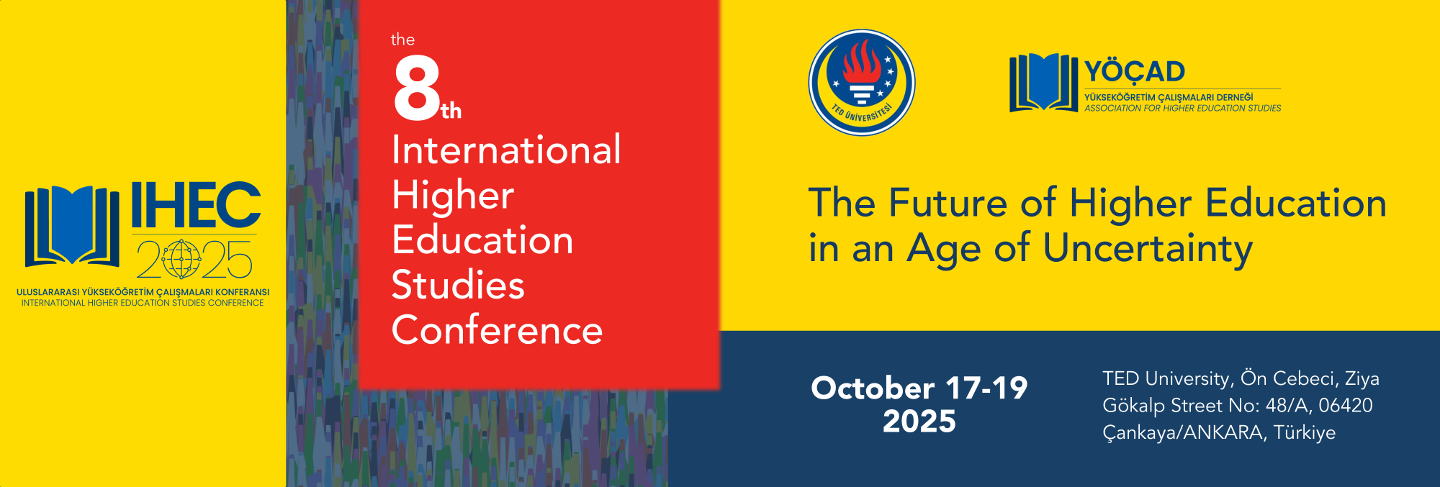
The Future of Higher Education in an Age of Uncertainty
Higher education, constituting an open and complex system, is shaped by its interactions with society, economy, culture, politics, nature, and other domains, whilst also playing an eminent role in shaping the future of the domains in question. From a historical perspective, major transformations such as the post-World War II era, which was marked by changes of profound sort in knowledge, science, education, and technology, along with the transition to a global knowledge economy/society beginning in the 1990s have also been periods during which higher education and universities were subjected to various forms of ‘restructuring’. The said periods have repeatedly prompted some fundamental questions like, ‘What is the university and what should it be?’, ‘What is and should be the role of higher education in constructing the future of our societies?’, and ‘What kind of a higher education reform is necessary to adapt to these transformations?’.
These questions also form the reason for the emergence of Higher Education Studies as an international and interdisciplinary field of research. Dwelling on and analyzing how these questions are mirrored in contemporary higher education policies necessitates collaborative, multi-disciplinary research initiatives, particularly in the fields of Educational Sciences, Social Sciences, and Humanities.
In recent decades, the accelerating pace of radical transformations alongside uncertainties pertaining to the future have compelled universities to develop ways through which they can sustain their existence within an ecosystem that calls for constant change. This externally driven and rapid demand for transformation has, in a fair number of respects, rendered traditional academic processes and the culture of universities and science increasingly unsustainable.
Within this frame of reference, at IHEC 2025, under the concept of ‘The Future of Higher Education in an Age of Uncertainty’, we intend to concentrate on the transformation of the missions of higher education viz. education, research, and community service in the face of multiple crises e.g., climate crisis, pandemics, economic crises, wars, migration, and others, on the challenges it encounters, and on the possible future scenarios. In this conference, which we expect it to be enriched with the contributions from scholars of diverse disciplines with distinct perspectives, we will broadly be addressing the following questions and themes: As the Association for Higher Education Studies, we are also pleased to be collaborating under this shared theme with TED University, founded in 2009 with the vision of ‘Leaving a lasting impact on social development for a sustainable future’.
How are the global policies on higher education evolving from the ‘Global Knowledge Economy’ toward the ‘Sustainable Development Goals’?
How will the trend towards massification in higher education be shaped by demographic changes? To illustrate, can massification continue in the countries in which birth rates are declining?
How are the pandemic and national protectionist tendencies impacting internationalization policies in higher education?
What pedagogical/andragogical approaches are coming to the fore in education and learning in the age of uncertainty?
How are learner profiles and experiences altering (with respect to intergenerational dynamics, poverty, identity, and alike)?
How do the current approaches to higher education administration and quality assurance models contribute to the effective functioning of universities under these conditions of uncertainty?
As the mental health and well-being needs of university stakeholders have become more crucial through the pandemic experience, how are these issues being addressed in higher education policies and practices?
How are digitization and Artificial Intelligence transforming the administration, education, research, and community engagement related missions of universities?
Conference Themes:
Academic freedom and autonomy of universities
Academic staff experiences and needs
Regional development and higher education
Science and technology policies
Digitization and Artificial Intelligence in education and research
Entrepreneurship, community engagement, development, sustainability
Graduate student experiences and needs
Micro-credentials and flexible learning
Faculty development policies
Higher education for the Sustainable Development Goals
Mental health and well-being of university stakeholders
University-city relations
University-industry/private sector collaboration and helix ecosystems
University students’ experiences and needs
New generation universities and alternative university models
Internationalization of higher education
Ethics, principles, and values in higher education
Quality assurance in higher education
Pedagogical/andragogical approaches in higher education
Access to higher education, equity, diversity, participation